
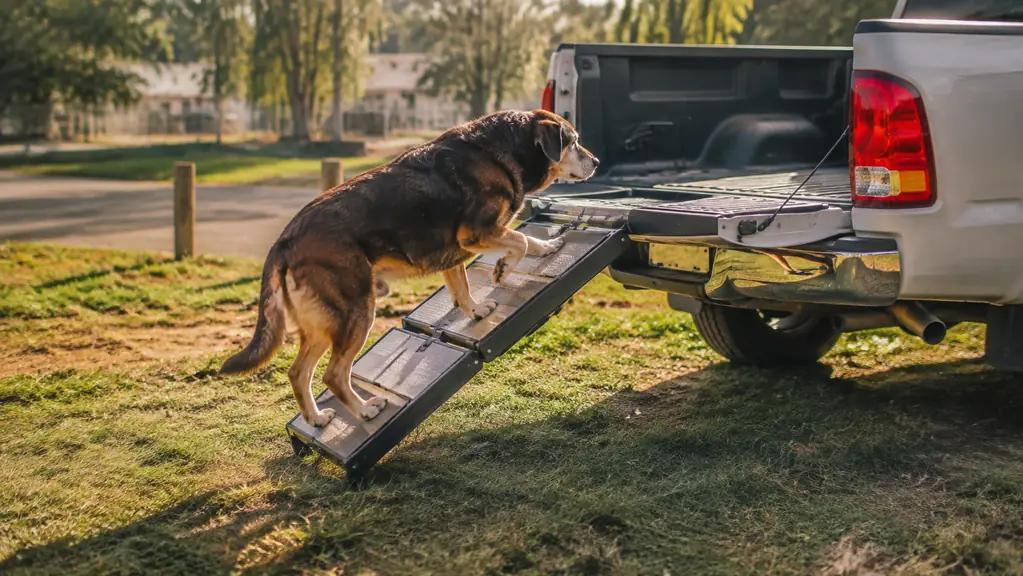
Boone turned nine this spring, and somewhere in that ninth year he stopped being able to jump into the back seat of my Ram. Not completely, not all at once. He would stand at the open rear door with his front paws on the sill and his back legs just hanging there, like he was waiting for me to tell him the ground had gotten farther away. On a cold morning in eastern Nebraska, with his hips stiff from sleeping on the floor of the cab, he would look up at me and I could see him doing the math. The jump was getting harder every month. I drive I-80 between Omaha and Salt Lake five days a week, and Boone rides in the back seat with his head out the window, so this wasn't a problem I could ignore. I either found a way to get a 74-pound dog into a truck without him jumping, or I left him home. That is how I ended up with the Pawaboo dog car ramp.
This is the long version of that review. Not the unboxing version, not the first-week version. I've loaded Boone with this ramp every workday for about five months, through a Nebraska winter that hit minus ten, through ice storms and gravel truck stops and rest areas where the only dry ground was a patch of pavement. I have opinions now, the kind you only get from using something a hundred times. Here they are.
The Quick Verdict
The 74-inch Pawaboo ramp makes the gentlest slope I found for a tall vehicle, and five months of daily use has not loosened a hinge or worn through the grip surface. The carrying handle is awkward and the folded ramp is bulky, but it does the only job that matters: Boone walks in and out of the truck on his own, on cold mornings, with no hesitation.
Amazon Check Today's Price →No more lifting 74 pounds of dog
If your dog has started doing the pause at the door sill, the long Pawaboo ramp is the fix. I've used it every workday for five months and I would buy it again.
Amazon Check Today's Price on Amazon →How I've Used It
Our routine is the same every morning. I back into a spot at the truck stop, set the parking brake, and get out while the defroster catches up. I open the rear passenger door, pull the ramp out from behind the seat, and unfold it in two motions. It hinges in the middle, so it goes from a 37-inch folded package to the full 74 inches in about five seconds. I set the top edge on the door sill and the bottom on the pavement, give it a stomp with my boot to seat it, and call Boone. He comes around from the passenger side, puts one paw on it, and walks straight up.
The part that surprised me is that he doesn't brace anymore. A few months ago he would stop at the bottom and I could see him testing the surface with one foot before committing. Now he walks up like it's a loading dock he's used his whole life. Down is the same story. He comes down slower than he goes up, which is normal for a dog with hip trouble, but he does it on his own and he does it without sliding. The grip surface has little raised ridges across the width of it, and after five months of ice, mud, and road salt, they still have their bite.
I've also used it at trailheads on the way home when he's tired, at the vet's curb, and once at a friend's place where the only way into the house was a step up onto a porch. Anywhere there's a height difference that Boone shouldn't jump, the ramp goes. That's what a ramp is for, and this one has been the right tool every time.
What the 74-Inch Length Actually Buys You
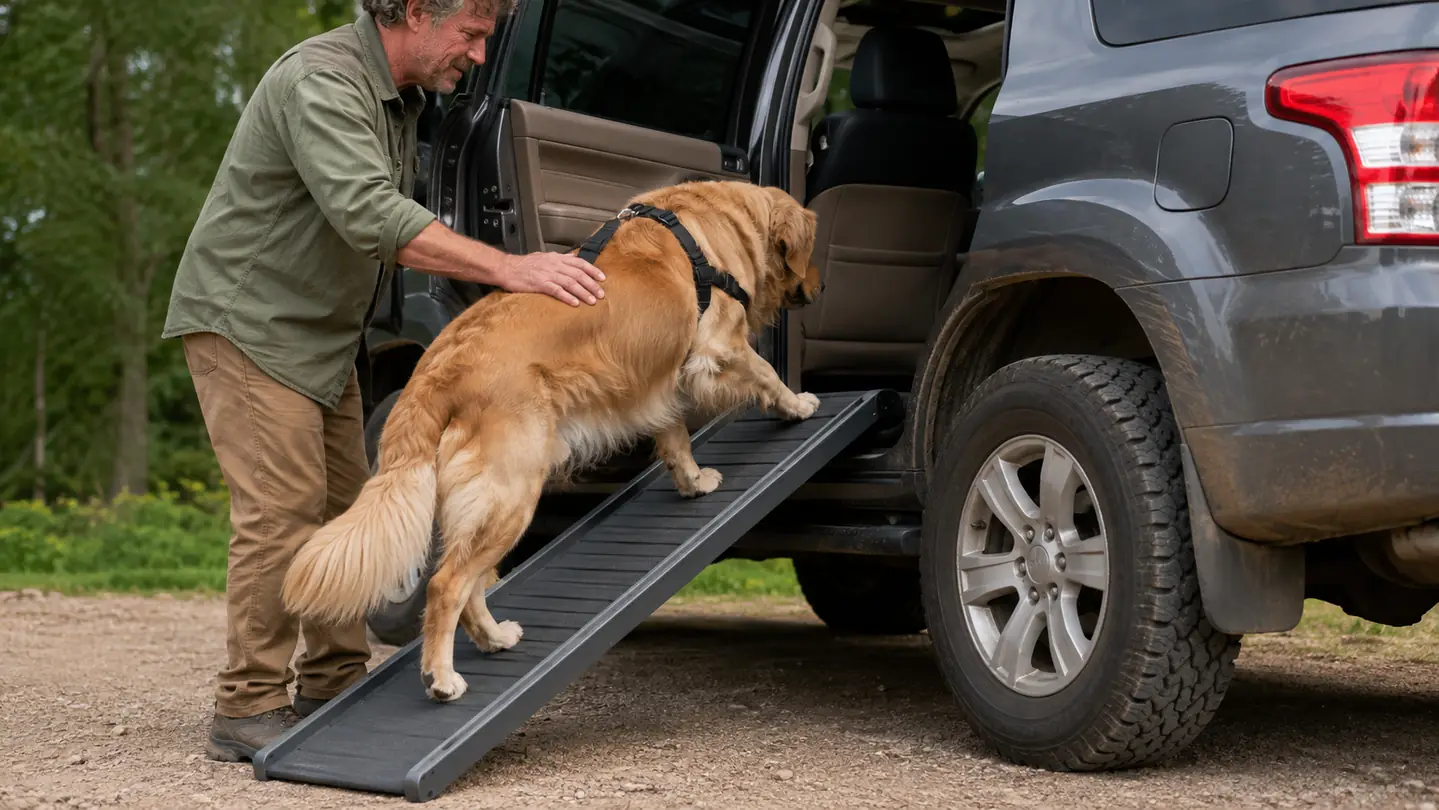
The biggest reason I picked this ramp over shorter ones is the math. A shorter ramp, say 55 or 60 inches, makes a steeper angle against the rear door sill of a crew cab. Steeper angles are harder for a dog with stiff hips because more of his weight rides on his front legs and he has to work to keep his back end underneath him. At 74 inches, the slope is gentle enough that Boone walks up at a normal pace instead of climbing. That difference is the whole product. It is the reason I stopped looking at every other ramp.
The width matters too. It's 20 inches across, which sounds wide until you watch a 74-pound dog use it. He plants his back feet wide when he walks, and on a narrow ramp he would be stepping with his feet half off the edge. On this one, all four feet stay on the surface the whole way up. I measured it against my boot and the ramp is roughly the width of two of my boots side by side. There's no wobble when he's on it, and I don't get the flex I felt on a cheaper folding ramp I tried once, where the middle bowed under his weight.
The other thing the length does is make the top of the ramp sit farther into the truck. With a short ramp, the dog steps off the top edge right at the sill and there's a gap between the ramp and the seat. With this one, the top edge reaches past the sill, so there's no moment where Boone has to step across a seam. On a morning when his hips are bad, that seam is exactly where he would hesitate.
Folding, Carrying, and the Realities of Daily Use
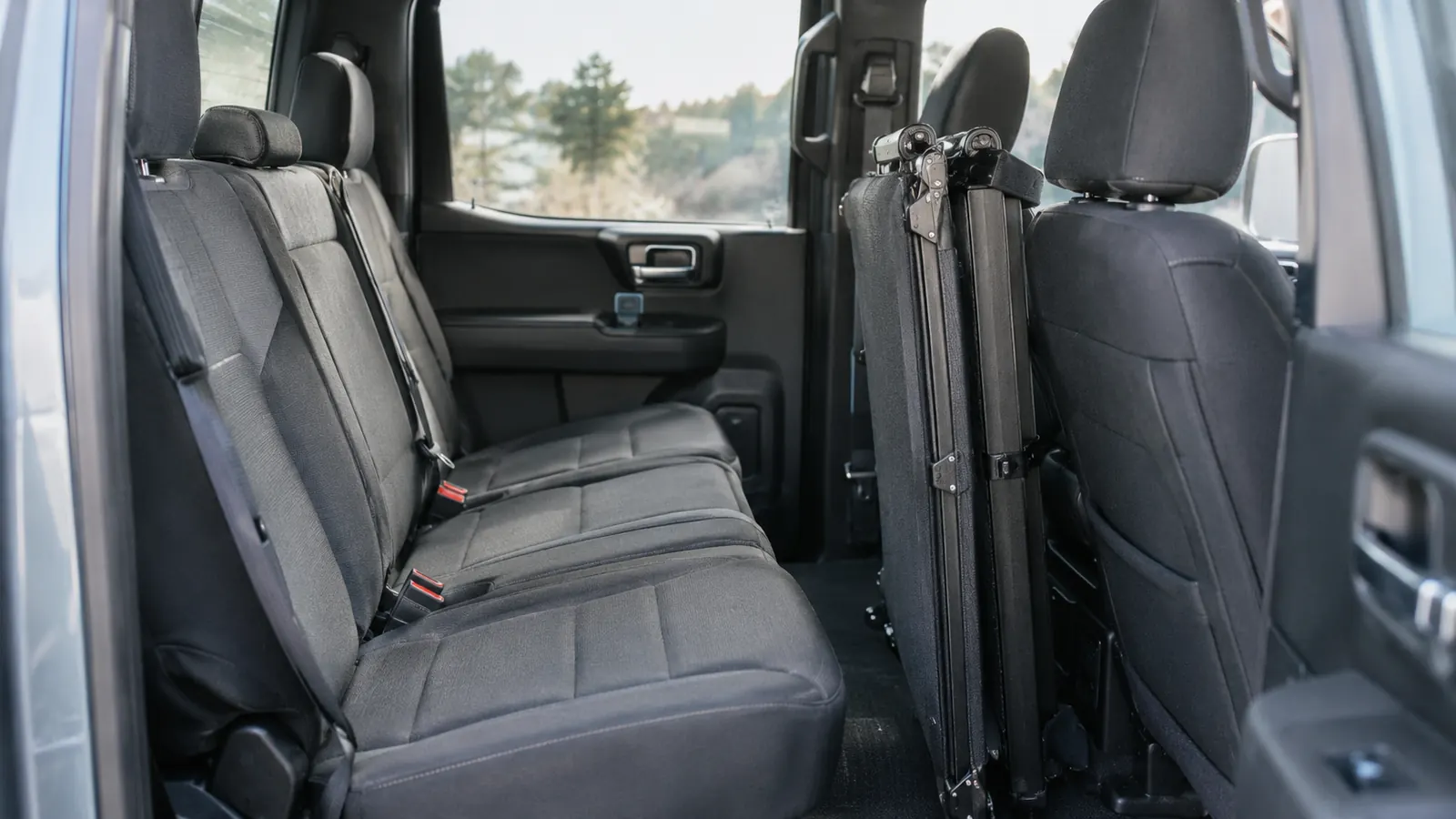
Here's the honest part. The ramp is not light and it is not small, and nobody should buy it thinking it disappears when folded. Folded, it's about 37 inches long and maybe six inches thick at the hinge, and it weighs enough that you notice it under one arm. In my crew cab, it lives wedged between the back seat and the rear door, and it stays put because it's pressed between two surfaces. If you leave it loose on the back seat, it will slide on the cloth and end up on the floor at the first hard stop.
The carrying handle is my one real complaint with the design. It's a molded handle near one end of one panel, and because the ramp folds in half, the handle ends up somewhere in the middle of the folded mass. The balance is wrong. I end up grabbing the ramp by the hinge instead, which works fine, but it means the handle is mostly cosmetic. It's a small thing. It doesn't affect the dog, and it doesn't affect the ramp's job. But if you are the sort of person who cares about a handle that balances, you will notice. My full list of small annoyances, without the long-term context, is in the honest review on this site.
The surface on the bottom of the ramp is what keeps it from sliding. It stays put on wet concrete, on gravel, and on ice, which I can tell you because I have used it on all three. The one setup that needs care is a slope in the parking lot. On a slight grade, I have to pick a spot where the pavement is level, or the ramp sits at a twist and Boone feels it under his feet. That's true of any ramp this long, so I don't count it as a mark against this one.
How Boone Took to It
The first week was a negotiation. Boone has never been a dog that trusts a new surface on sight, so I spent the first few days with a pocket full of training treats, luring him up one step at a time. I would put one paw on the ramp, treat. Two paws, treat. Front half, treat. He figured out that the ramp meant he got to go for a ride, which is his favorite thing in the world, and within about a week he was walking up without the treat at all.
The behavioral change is the part I didn't expect. Before the ramp, loading him meant a run-up and a jump, and on bad mornings it meant me with a hand under his back end. He would brace at the door and I could tell he was dreading it. Now he walks to the ramp, waits for me to set it, and goes up at a walk. The stall at the door sill is gone. For a dog with arthritis, not having to launch himself is a huge quality-of-life thing, and I can see it in how willing he is to get in the truck now.
Coming down is still the harder direction for him. He takes it slow, one paw at a time, and the ramp's grip surface earns its keep there. I have watched him descend with his weight well back, and his feet do not slip. On ice, I still spot him from behind, mostly because I don't trust any surface under his feet in single-digit weather, but the ramp itself has never been the thing that let him down.
What Has Worn Down After Five Months
The grip surface is the first thing I check, because it's the thing that touches the dog, and it has held up. After five months of daily use, including a Nebraska winter of road salt and ice melt, the ridges are still there and they still have texture. There are some scuffs on the edges where the ramp has scraped against curbs and door sills, but nothing has peeled and nothing has gone slick. I hose it off at the car wash and it looks close to new.
The hinge is the second thing I check, and it's still tight. There's no lateral play when it's unfolded, no rattle when it's folded and wedged behind the seat. That matters to me because I live in that cab all day and I cannot stand a rattle. The latch that holds it closed when folded still clicks solidly. I have not had to tighten a screw or adjust anything in five months.
The honest wear items are the edges and the bottom. The bottom picks up scuffs from pavement and gravel, and the edge where the ramp meets the door sill has picked up more scuffs from rubbing against the truck's paint and weatherstripping. None of it affects function. If you're someone who needs your gear to stay pretty, you'll notice. If you're someone who needs it to work, you'll be fine.
Alternatives I Considered
Before I landed on the Pawaboo, I tried a shorter folding ramp that belonged to a friend, and it worked until it didn't. The middle flexed under Boone's weight and the slope was steep enough that he balked at the top. I also looked hard at the telescoping options that extend from a short package, but the reviews all mentioned the same thing: the sliding sections develop play over time. A hinged design with one solid surface has fewer moving parts to loosen up.
Stairs were the other serious option, and I still think they're the right call for some setups. But for a truck, where the door sill is high and the stairs would need to sit level on uneven pavement, a ramp is simpler. There's a fuller ramp-versus-stairs comparison on this site that walks through exactly when each one makes sense.
What I Liked
- The 74-inch length makes a genuinely gentle slope for tall trucks and SUVs
- 20-inch width gives a big dog room to plant all four feet
- Grip surface still has bite after five months of ice, mud, and road salt
- Solid under a 74-pound dog, with no flex in the middle
- Folds to about 37 inches and stores behind the rear seat
Where It Falls Short
- Carrying handle is awkward and the folded ramp balances wrong in your hand
- It's bulky, and it slides around the cab unless it's wedged in place
- Setup takes two hands and a level parking spot
Five months in, on a cold morning, Boone walks up that ramp without being asked. That's the whole review, right there.
Who This Is For
Buy the Pawaboo ramp if you've got a large dog that has started hesitating at the door. Buy it if you drive a truck or a tall SUV, because the length is what makes the slope workable. Buy it if you spend a lot of time on the road and you want a loading routine that doesn't depend on your dog having a good day. Boone is 74 pounds with stiff hips, and this ramp has turned the hardest part of every trip into a ten-second walk. If that's your situation, this is your ramp.
Who Should Skip It
Skip it if your dog still jumps into the car without thinking, because then you're buying a bulky object to solve a problem you don't have. Skip it if you drive something low to the ground, like a sedan, because the 74-inch length is overkill and a shorter ramp would be easier to store. Skip it if you have a small dog, because the width and the weight are more than you need. And skip it if you aren't willing to spend a week teaching your dog to use it. The ramp does not train your dog. You do. If that sounds like a hassle, this isn't the product that fixes your problem.
The ramp I'd buy again tomorrow
Five months of daily use, a hard winter, and Boone walks up on his own every time. If your dog needs the same help, this is where I'd start.
Amazon Check Today's Price on Amazon →