
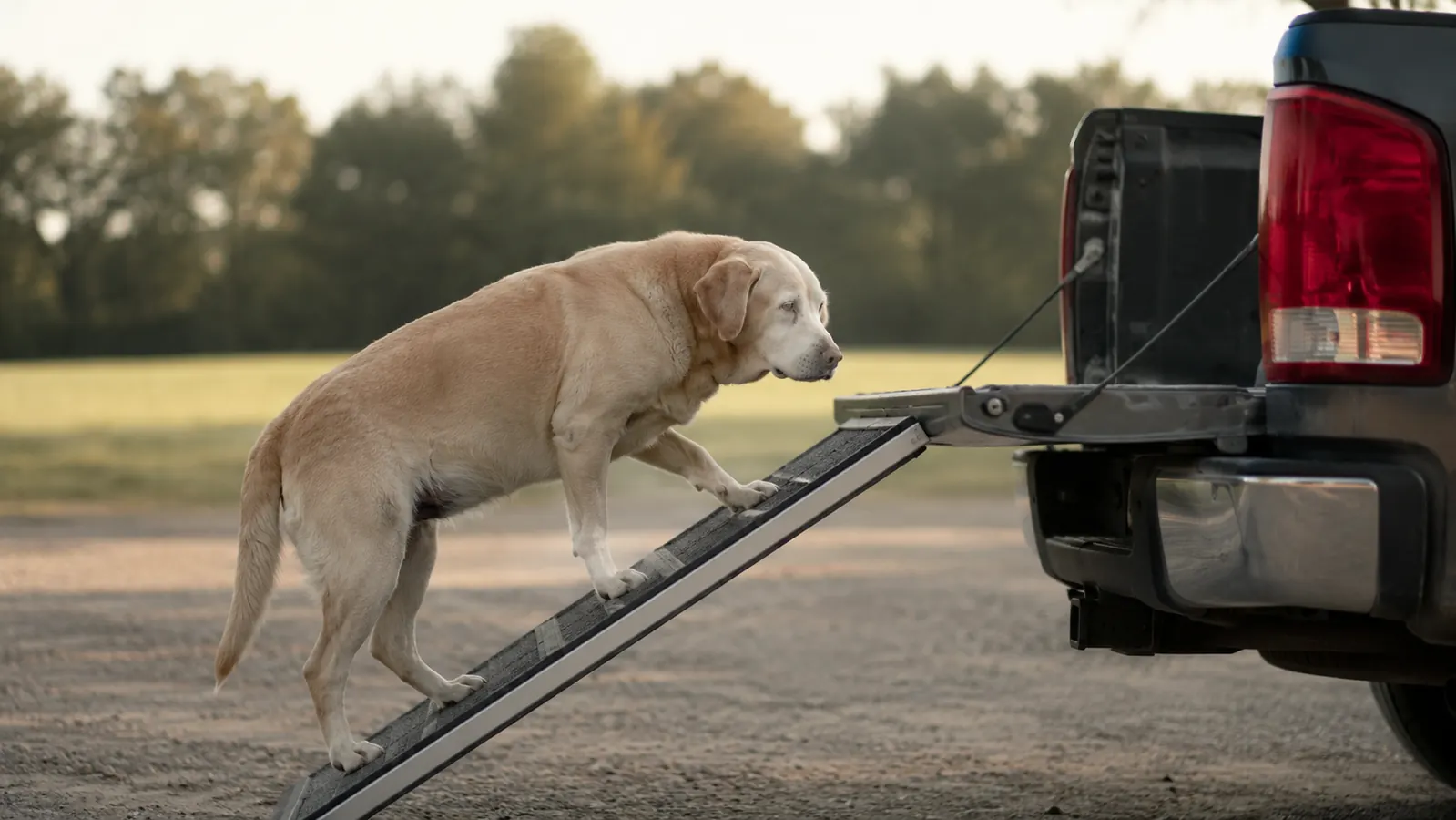
The first time I tried to lift Boone into the truck bed, he was eight, and he let me know it. My back let me know it too. A 74-pound yellow Lab mix with stiff hips is not going to jump into a lifted Ram 1500, and I am too old and too honest to pretend otherwise. So I went looking for something to get him up there without hurting either of us. That search landed on the two options everyone argues about: a dog car ramp and a set of folding dog stairs. I tested both for a month, twice a day, on flat pavement, gravel lots, and wet grass. Here is what I learned and which one I kept.
The short answer is that the Pawaboo 74-inch dog ramp won, and it was not close. For a tall vehicle and an older dog with a stiff back end, the ramp's long, gentle slope is exactly what the vet would order. Boone walked up it the first time without hesitating, and he has never once refused it since. The stairs are lighter, cheaper, and easier to store, and I will tell you exactly who they are right for. But if your truck sits as high as mine and your dog is as old as mine, the Pawaboo ramp is the one that gets used. It earned the permanent spot in my truck bed, and it is the one I would tell a fellow driver to buy first.
| Pawaboo 74" Ramp | Folding Dog Stairs | |
|---|---|---|
| Reach for tall vehicles | 74 inches of ramp length handles a pickup tailgate or a tall SUV without a steep angle | 2 to 3 steps top out around 15 to 18 inches, which is fine for a car but a stretch for a truck |
| Load on stiff hips | Continuous slope lets the dog walk up instead of climbing; kinder to an older, arthritic hind end | Each step loads the rear legs from a standstill; harder on a dog that is already stiff in the mornings |
| Price | Costs more upfront; check today's price to see where it lands | Usually the lower-cost way to get a small dog into a low vehicle |
| Folded size and weight | Long folded footprint that lives in the truck bed, garage, or against a wall | Folds flat and light enough to keep behind a seat or in a trunk corner |
| Setup time | Unfold, set the lip on the tailgate, check the angle; 30 seconds once you have done it a few times | Unfold and set on the ground; quicker for a low car, but you may need a second position for a taller vehicle |
| Stability on uneven ground | A 20-inch-wide platform spreads the dog's weight and stays put once the base is level | Rubber feet help on hard ground, but a 74-pound dog stepping up can rock the set on soft or sloped ground |
| Best for | Older, stiff, or large dogs and tall vehicles like trucks and SUVs | Small or still-springy dogs in cars, crossovers, and low SUVs |
How I Tested Both
I set up a simple test: every morning and every evening for a month, I loaded Boone into the truck with both options, alternating between the Pawaboo ramp and the borrowed stairs. Same truck, same dog, same tailgate height, which is about 30 inches with the bed at its normal ride height. I timed each load, watched how Boone moved, and made a note of anything that felt unsafe. I also left both on the porch and used them for the porch steps and the deck, because a dog that only sees a ramp once a week will never be smooth with it. The point was not to find the prettiest gear. It was to find the thing I could use every day without Boone hesitating and without me straining my back.
I kept the dog's comfort and the dog's safety first, but I rated the gear as gear too. I carried both to the truck on gravel, used both in the rain, and stored both in the cab and the bed to see what actually fits a crew cab. I folded and unfolded each one fifty-plus times to find the little annoyances that only show up with repetition. None of this is a lab test. It is a month of real use by a guy who drives a truck for a living and brings his dog along. That is the perspective I am writing from.
Where the Pawaboo Ramp Wins
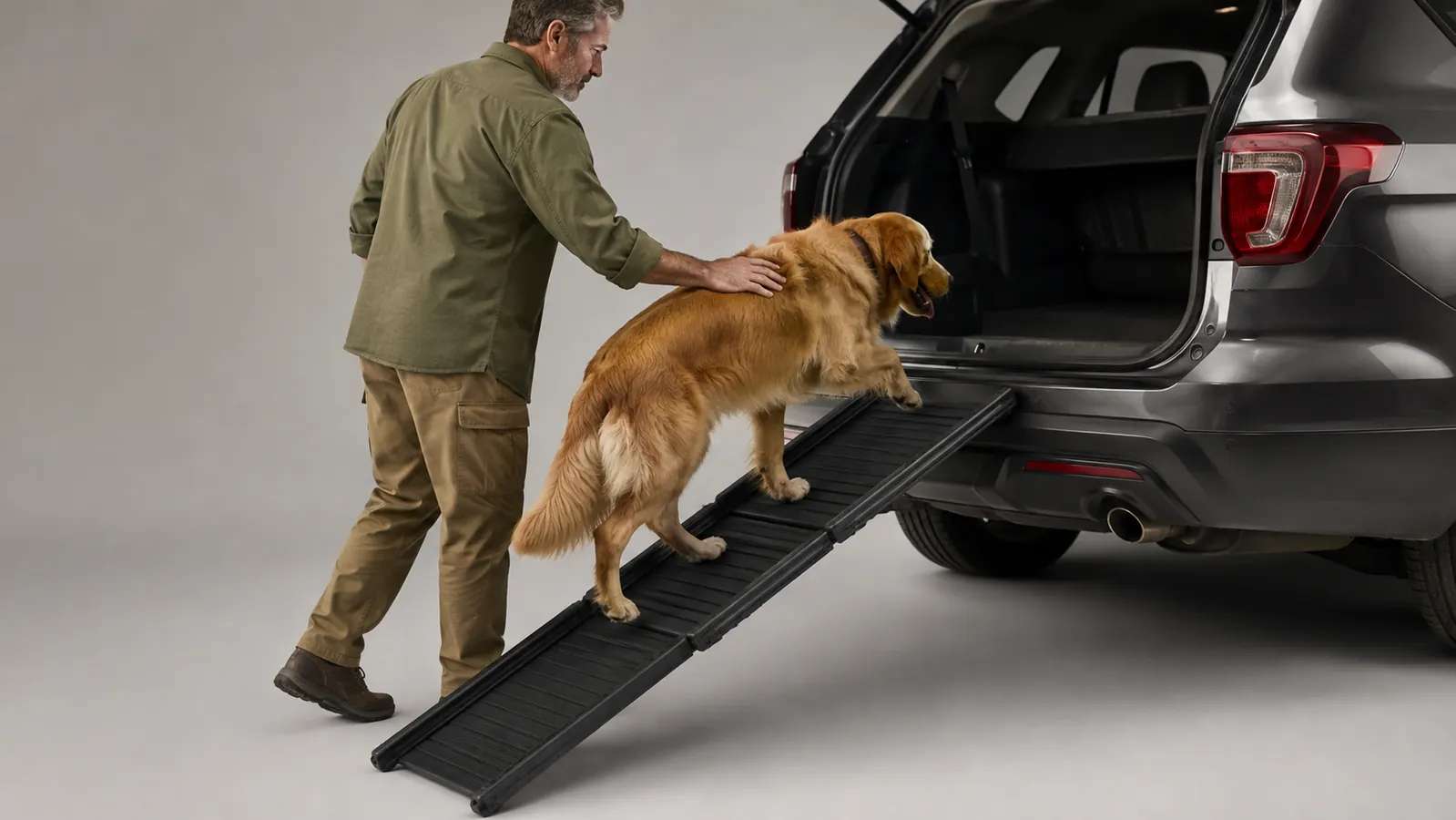
The ramp wins on the one thing I could not fix with better stairs: the angle. Boone's hips are stiff in the morning, and stairs force a dog to push his whole weight up from a standstill with his back legs. The Pawaboo ramp spreads that same climb across 74 inches, so his back end stays under him and he walks up the way he walks across a parking lot. The first morning I used it, I was braced to catch him. He just walked up, turned around, and lay down on the seat. I have loaded him on mornings cold enough that he limped to the tailgate, and the ramp was still the easy part of the day.
The width and the edge matter more than I expected. The 20-inch span gives Boone enough room to correct himself if he steps sideways, and the raised edges keep his feet from sliding off the side. The walk surface has enough grip that his feet stayed planted even on a wet, dewy morning, which matters because I have watched him slip on wet grass and do the splits. I also use the ramp at the deck, the porch, and the vet's front step. One piece of gear covers every tall step in a dog's life.
There is also the matter of my back. I am in my mid-fifties and I move freight for a living, so the last thing I need is a 74-pound dog putting all his weight on my knees while I lift his hind end into a truck. The ramp removes that entire problem. Boone walks up on his own and I just hold the edge for two seconds until he clears the tailgate. If you are the one doing the lifting every day, the ramp is doing as much for you as it is for the dog.
Where Dog Stairs Win
I will start with the honest part: for plenty of people, the stairs are the right buy. They cost less, and they fold down small enough to live behind a back seat, which the ramp cannot do. My neighbor's set lived in the trunk of her sedan, and her 40-pound mix stepped up and down like it was nothing. If your step-in height is low, your dog is small or still springy, and your vet has not started talking about joints, the stairs will get the job done with less money and less storage space. I would not talk anyone out of that.
The stairs lost in my truck for two reasons, and both were Boone-sized. At 74 pounds, stepping up onto the first tread loads his hind legs from a dead stop, and I could see him hesitate before every single load. Some mornings he would set one paw on the tread and just stand there. That hesitation on a tailgate is how a dog ends up on the pavement. The other problem was reach. Two steps get a small dog into a car, but they do not get a 74-pound Lab into a Ram 1500. I had to set the stairs on the tailgate and then use a second step up into the seat, which made a ten-second job into a small project every time. By the end of the month, the stairs were back in my neighbor's garage.
I also found the stairs less forgiving on uneven ground. On flat pavement they were fine. On gravel or a sloped driveway, the whole set wanted to rock when Boone put his weight on the top step. The rubber feet helped, but I never fully trusted it, and trust is the whole game when you are loading a dog that cannot catch himself if the gear moves.
The Ramp That Finally Got Boone Into the Truck
After a month of twice-daily loading, the Pawaboo 74-inch ramp is the only option that gets a stiff 74-pound dog into a lifted truck without hesitation. If your vehicle is tall and your dog is older, start here instead of the cheaper stairs. Check today's price on Amazon and see if it fits your setup.
Amazon Check Today's Price on Amazon →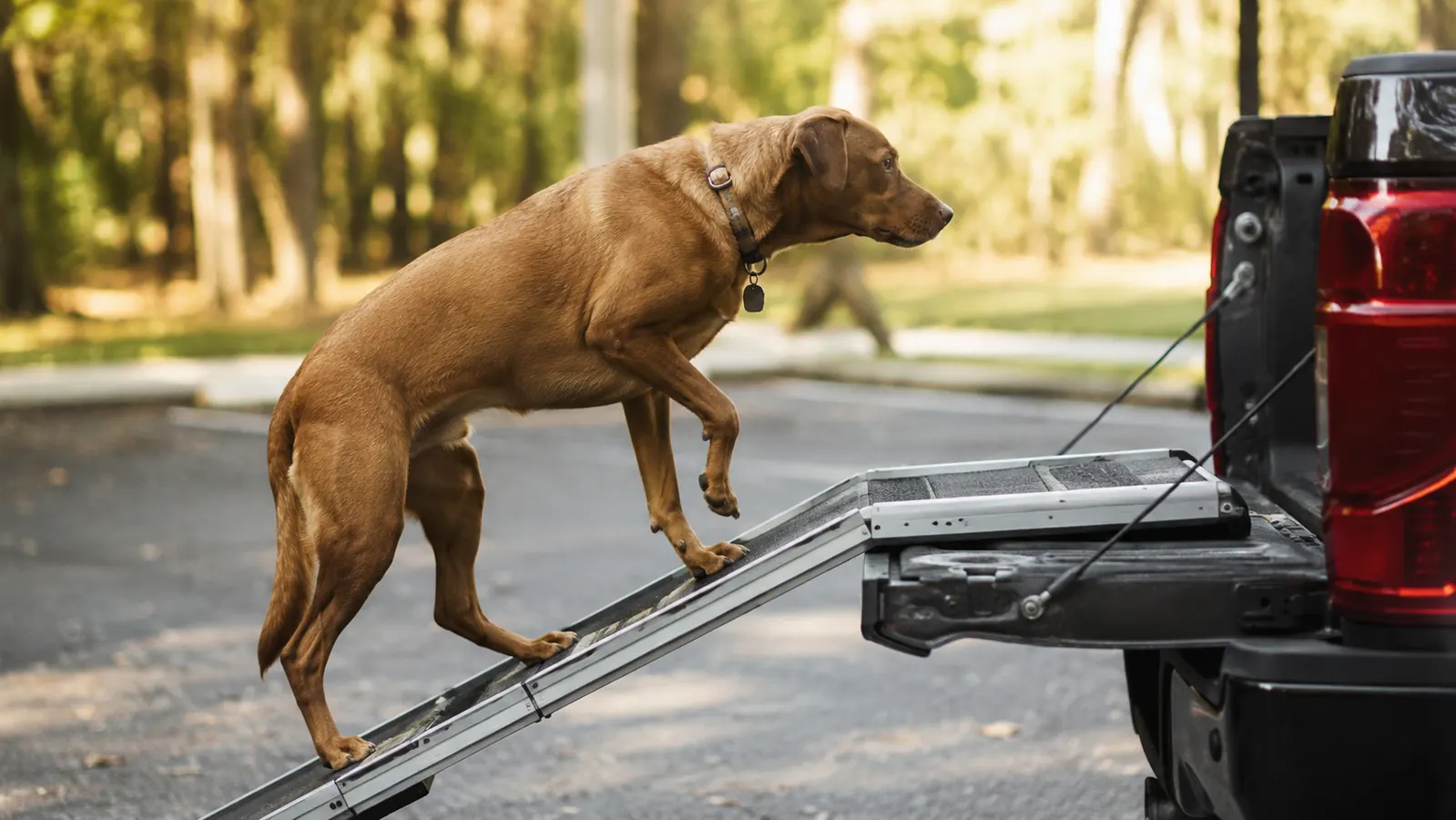
Who Should Buy Which
Buy the Pawaboo ramp if you drive a truck or a tall SUV, if your dog is large, older, or already showing stiffness in the hips, or if you want one piece of gear that works at the tailgate, the deck, and the porch. It is the pick for anyone who is doing the lifting today and wants to stop. The price is higher than the stairs, but I have learned the hard way that the cheap version of the wrong tool costs more in the end.
Buy the stairs if your vehicle sits low, your dog is small or still hops around without a second thought, and your storage space will not fit a 74-inch ramp. A small dog does not need a ramp; he needs a step. And if you mostly drive a car with a low doorsill, the stairs are lighter, cheaper, and easier to keep out of the way. Choose based on the height of your step-in and the condition of your dog's back end, not on which one looks more impressive in the garage.
One more thing: age changes the answer. A ramp for a young dog feels like overkill until that same dog is nine and hesitant at the tailgate. Boone could jump into the truck easily at four. At nine, with a greying muzzle and stiff mornings, he will not even try. If you are buying for a dog that is still young, the smarter move is to buy the ramp now and teach him to use it while it is easy. You will need it later.
What I'd Tell a Fellow Driver
If we were standing next to my truck, here is the plain version. Measure the height of your tailgate or your SUV doorsill before you buy anything. Then watch your dog try to get up. If he hops, stairs are fine. If he hesitates, plants his front feet, and leaves his back feet on the ground, that is your answer. He is not being stubborn. He is telling you the step is too high for his hips, and no amount of treats will fix that.
The ramp is not magic. It is a flat surface at a reasonable angle, which is what an older dog needs. The Pawaboo version does that job well, folds down when you need the bed, and came through the whole month of daily use without a complaint. If you want the full picture, my [long-term review](/dog-car-ramp-review-long-term/) covers how it holds up over many more loads, and the [truck-loading guide](/how-to-load-dog-into-truck-with-ramp/) walks through the setup step by step. Read both, then make the call. I would rather you buy the ramp a week late than buy the stairs and buy the ramp a month after that.
The Bottom Line
The question was never really ramp versus stairs. The question is what your dog will do twice a day without hurting himself, and what you can lift and store without hurting yourself. For an older dog and a tall vehicle, the Pawaboo ramp is the answer. I have written a [long-term review](/dog-car-ramp-review-long-term/) of the 74-inch ramp if you want to know how it holds up after months of road use, and I put together a [guide on loading a dog into a truck with a ramp](/how-to-load-dog-into-truck-with-ramp/) that covers the setup in detail. Both are worth a read before you hand over your money, because the right answer depends on your truck and your dog.
Still Torn? Start With the Ramp
A ramp handles tall vehicles, stiff hips, and a heavier dog in one purchase. The stairs save money only until the day they do not reach. I have used the Pawaboo ramp every day since the test ended. See what it is going for today on Amazon and decide with real numbers in front of you.
Amazon Check Today's Price on Amazon →