
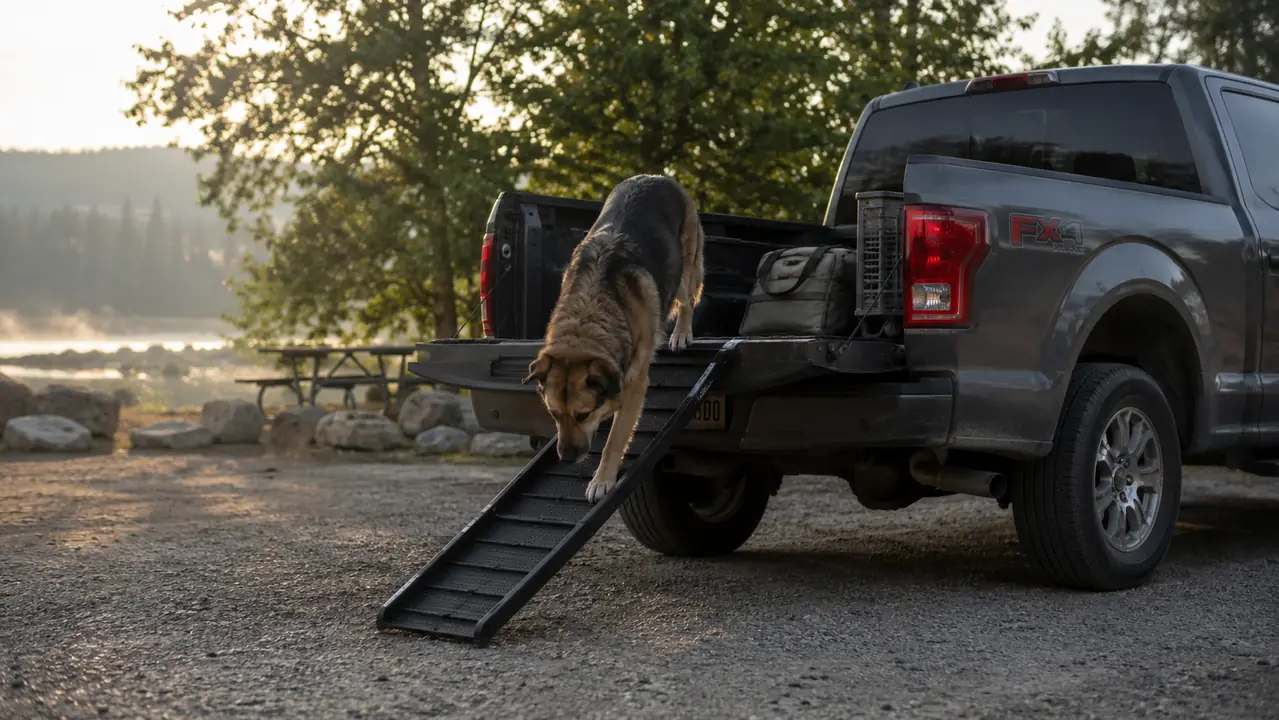
You want the honest version, not the listing copy. Fine. I have had the Pawaboo 74-inch folding dog ramp for eight months now, and I have used it almost every day with Boone, my 74-pound yellow Lab mix. He is nine years old, his muzzle is grey, and his hips stiffen up when the temperature drops, which matters when you live in eastern Nebraska and run I-80 between Omaha and Salt Lake. Lifting him into the cab of my 2019 Ram 1500 by hand was getting harder on both of us. Letting him jump was worse. So I went looking for a ramp, and I read more reviews than I care to admit before I picked this one.
Here is what I wish someone had told me before I bought it. The ramp is long, which is exactly what you want for a tall vehicle, but it is also big, and it does not do you any good sitting in a closet. The dog has to actually use it, and that takes training. The surface matters more than the length. I will get into all of it, but the short version is that I have kept the Pawaboo and I would buy it again. It is not perfect, and I will tell you exactly where it falls short.
The Quick Verdict
The longest, most practical folding ramp I found for a tall truck and a big dog with stiff hips. It holds up, it grips, and Boone uses it without a fight. The downsides are storage size and a fold latch that needs watching.
Amazon Check Today's Price →The ramp I set up at every single stop
Eight months, roughly 40,000 miles, and a dog who no longer hesitates at the tailgate. That is what the Pawaboo ramp bought us. Here is the full honest breakdown, including the parts that annoy me.
Amazon Check Today's Price on Amazon →How I've Used It
Boone rides in the back seat of the crew cab, not the bed. For the first few weeks I used the ramp at the rear door, angling it from the ground up to the sill so he could walk in instead of climbing. That worked, but the better setup for us turned out to be the tailgate. I lower the tailgate, set the ramp on the edge, and let Boone walk straight into the bed, then step down into the cab. He figured it out within a week.
A normal day for us starts before sunrise at a truck stop outside Omaha. I fold the ramp out, set it on the tailgate, and Boone trots up on his own while I do my walk-around. When we stop for fuel or a meal, same thing. On a long run I probably set it up and take it down eight or ten times a day. That repetition is the real test. A ramp that works once in a driveway is one thing. A ramp that works at a rest area in the dark, in the rain, at a gravel lot in Wyoming in February, is another thing entirely. I count the setup and takedown as part of the walk-around. It adds maybe twenty seconds to every stop, which is nothing compared to the time I used to spend coaxing Boone to jump or waiting for him to find the courage.
I also use it at home. Boone has always been a truck dog and he expects to ride along for errands. The Pawaboo lives in the cab, leaned against the back of the front seat. When we get home I set it up one more time, he walks down, and I fold it away. The routine took maybe two weeks to feel completely normal, for both of us.
What Nobody Tells You Before You Buy a Dog Ramp
The first thing nobody tells you is that the dog has to be taught to trust it. Boone is not a nervous dog, but the first time I put that ramp on the tailgate he looked at me like I had grown a second head. I did a lot of slow sessions with treats, a lot of standing at the top waiting for him to see that it was solid, before he would walk up on his own. It took about ten days before he would trot up without a treat at the top, and another week before he stopped pausing at the bottom to check the surface. Every dog is different. A younger, bolder dog might take two days. An older, cautious one needs more time. If your dog is already wary of slippery floors, start with the ramp flat on the ground and let him walk across it before you angle it up to the truck.
The second thing is that a ramp does not do the whole job for a dog with bad hips. It takes away the impact of the jump, which is the main thing. But Boone still has to climb, and on a cold morning he sometimes needs a hand on his hip or a moment at the top before he commits. I use the ramp to make the jump smaller, not to pretend the climb has disappeared.
The third thing is that the length you need depends on the height of your vehicle, and the math is not complicated. A 74-inch ramp on a stock-height Ram 1500 makes a gentle slope. The same ramp on a lifted truck is going to be steeper, and the steeper it gets, the harder it is for a dog with arthritis in his hips. If you drive a tall truck, buy the longest ramp you can. This one is the longest folding option I found in a size that still stores inside a crew cab.
The Ramp Itself: Length, Width, and the Surface That Matters
The headline feature is the length. At 74 inches long and 20 inches wide, this ramp is made for larger dogs and taller vehicles. That length spreads the climb out, so Boone is walking up an incline instead of scrambling. For his age and his hips, that is the whole point. The width gives him room to place his feet without feeling like he is on a balance beam. An 18-inch-wide dog on a 20-inch-wide ramp is a comfortable fit. It would still work for a wider dog, but I would not call it generous for a giant breed.
The surface is where I was pleasantly surprised. The ramp has a textured, nonslip tread that runs the full length, and it grips Boone's paws even when it is wet. I have used it in rain, on frost, and on gravel, and I have not seen him slip once. That is the detail that separates a good ramp from an unsafe one. A dog that slips once on a ramp will be suspicious of it forever.
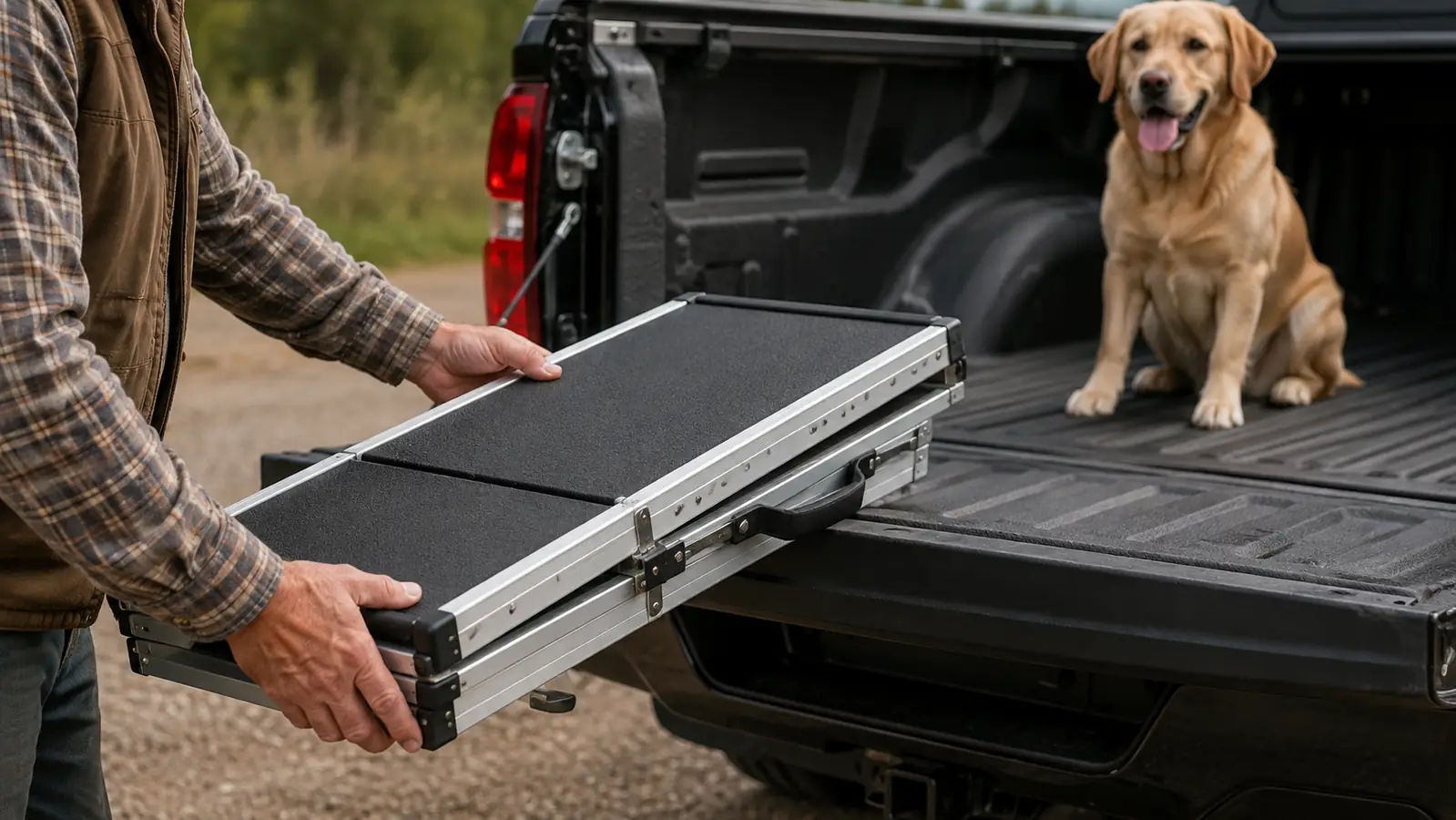
The frame is light for its size and stiff enough that it does not flex when Boone puts his full weight in the middle of the span. It sits on grippy feet that keep the ramp from skating sideways on pavement. The one piece I would change is the folding latch. It works, but it takes a firm pull to release, and after months of daily folding it has developed a little give. It has not failed, but it is the part I watch.
Six Months of Daily Use: What Holds Up and What Doesn't
I bought this ramp in late spring, which means I have used it through summer heat, fall rain, and the start of a Nebraska winter. The frame has no chips and no corrosion. The tread still grips. The hinge pins have not loosened. I am hard on gear, and the Pawaboo has taken more abuse in eight months than most ramps see in a driveway. It has held up.
What does not hold up as well is the latch, as I mentioned. It still works, but the release is stiffer than it was on day one, and I find myself having to pinch it just right. I also wish the ramp came with a carry strap that was easier to use one-handed. You can carry it by the frame, but at this length it wants to swing. When you are also managing a dog and a truck door, an extra hand would help. The latch is the only thing I have had to think about. I have not had to replace it, and I do not expect to soon, but I would not be surprised if it is the first part to wear out on a ramp used as hard as this one.
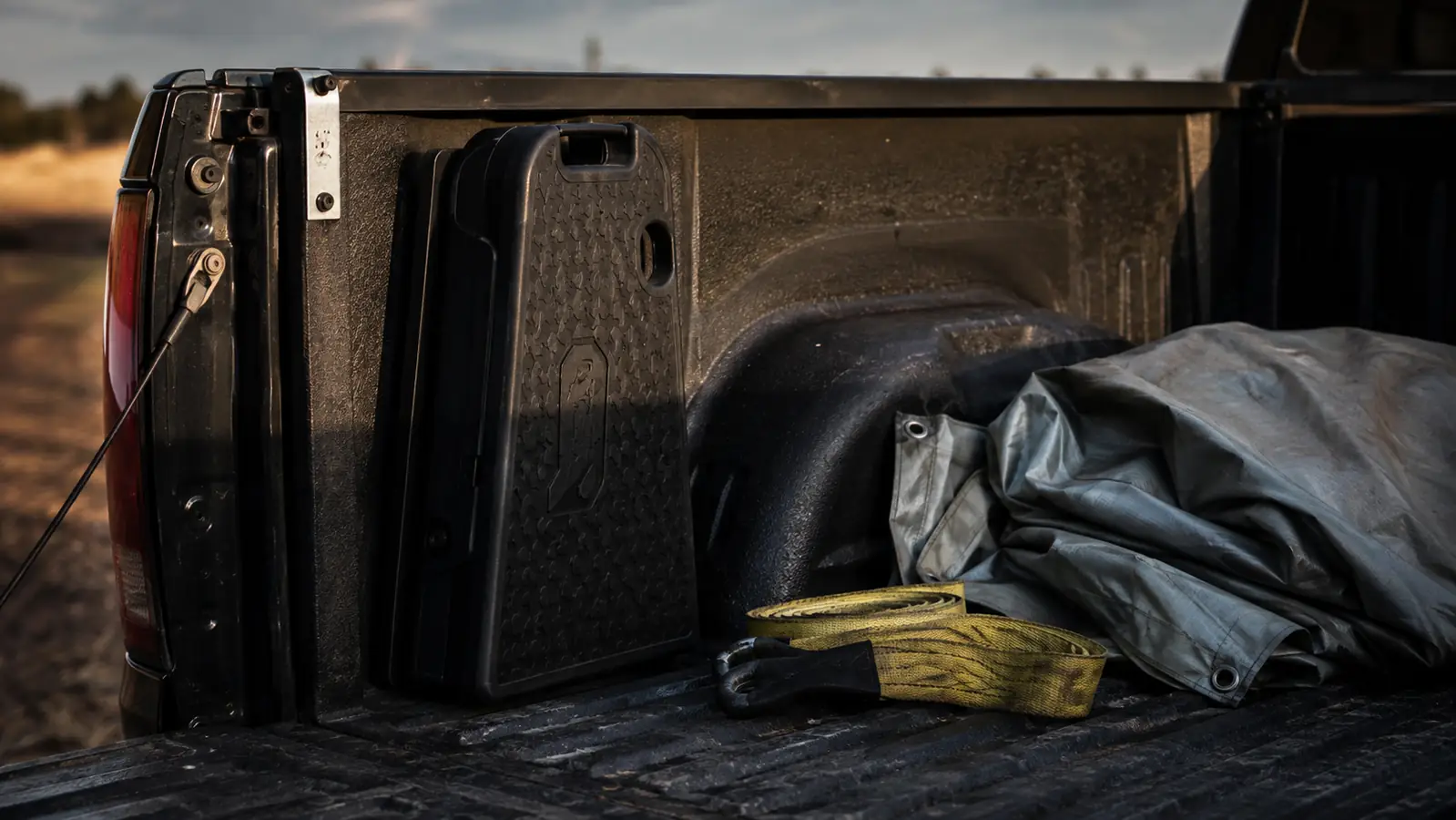
The honest note on storage. This is a big object. Folded, it is still roughly the length of the truck's back seat, and it takes up real space in the cab. I keep it leaned against the back of the front seat and it works, but it does not disappear. If you were hoping for something that fits under a seat or in a small trunk, this is not that product.
The Tradeoffs and the Alternatives I Considered
The first tradeoff is the storage footprint. You are buying 74 inches of ramp, and no amount of clever folding changes the fact that long is long. If your car is a compact sedan and you already struggle to fit groceries, this ramp will be a problem. In a crew cab pickup, it is fine. Be honest with yourself about where the ramp will live before you buy.
The second tradeoff is the training time. I said it once, and I will say it again. The ramp only works if the dog uses it. I have talked to other drivers who bought ramps and gave up after three days because their dog would not walk up. That is not a ramp problem. That is a training problem. If you are not willing to spend two weeks on slow, patient sessions, save your money.
The third tradeoff is that the ramp shines at a tailgate or a door sill, and it is less useful when you cannot get the angle right. On uneven ground, the feet do their job, but you have to find a spot where the ramp sits flat. At a tilted parking lot you might need to reposition the truck. These are small things, but they are real, and nobody puts them in the product photos.
Before I settled on the Pawaboo, I looked at telescoping ramps, which fold down shorter for storage. They are easier to stow, but the telescoping sections in my price range felt less rigid, and a ramp that flexes under a 74-pound dog is a ramp I do not trust. I also looked at shorter two-piece ramps, around 50 inches. They store smaller, but on the Ram the angle gets steep, and steep is exactly what I was trying to avoid.
I considered folding pet stairs. They are genuinely good for some vehicles, and they are easier to get a nervous dog to use because each step is a small commitment. But on a tall truck, stairs take up more space at the tailgate, and Boone is at an age where a steady ramp is kinder on his hips than climbing steps.
What made me keep this one was the combination of length and width. A long, wide ramp with a real grip surface, at a weight I can carry one-handed, is a rare combination. The Pawaboo is not the cheapest ramp on Amazon, and it is not the smallest, but it is the one that fits the actual job, which is getting a stiff old dog in and out of a tall truck without either of us getting hurt.
What I Liked
- 74-inch length spreads the climb out, so a big dog walks instead of scrambles
- Nonslip tread grips even when wet; Boone has never slipped
- Light enough to carry one-handed despite the length
- Frames and hinges have held up through eight months of daily use
- Folds in half and stands on its own against a seat
Where It Falls Short
- Folded length still takes up real space in a cab or trunk
- The dog has to be trained; it is not plug and play
- Folding latch has gotten stiffer with use
- Not ideal for small cars or very low vehicles
Eight months and roughly 40,000 miles of rest stops, and Boone still walks up that ramp without a pause.
Who This Is For
This ramp is for anyone with a large dog, a tall vehicle, and a dog who is starting to hesitate before a jump. If your dog is nine and stiff in the hips, or if you are tired of lifting 70 pounds into a cab, this is the product. It is also for people who are willing to spend two weeks teaching their dog to use it, because the payoff is a dog who can keep traveling with you for years. Boone has always loved the truck, and the ramp is the reason he still gets to ride along. A dog that cannot get in and out safely is a dog that gets left home, and nobody who drives with a dog wants that.
Who Should Skip It
Skip it if your dog is small enough to pick up, or if your vehicle is low enough that your dog already hops in without a problem. Skip it if you drive a small car and have nowhere to store a folded ramp this long. And skip it if you do not have the patience for training, because the ramp is only as good as the dog's willingness to walk on it.
Buy the ramp before your dog needs it
I waited until Boone's hips were already bothering him, and the training took longer because he was sore. If your dog is only starting to hesitate at the tailgate, that is the moment to buy. The ramp is the difference between a road trip and a reason to stay home.
Amazon Check Today's Price on Amazon →